
The Nasdaq Composite is one of the most widely followed stock market indexes in the United States. It is often referred to simply as the “Nasdaq” in financial news and market discussions, which can create confusion because the Nasdaq Stock Market also has other major indexes, including the Nasdaq-100.
The key distinction is that the Nasdaq Composite is a broad measure of eligible stocks listed on the Nasdaq Stock Market. It includes thousands of securities across different industries and company sizes, rather than focusing only on the largest non-financial companies.
Understanding how the index is constructed helps explain what its daily movement actually tells investors, why technology companies have such a strong influence on it, and why its performance does not always match the Nasdaq-100.
What Is the Nasdaq Composite?
The Nasdaq Composite Index measures eligible domestic and international common-type stocks listed on the Nasdaq Stock Market. It was launched in 1971 and has grown into one of the most closely watched benchmarks for Nasdaq-listed equities.
Unlike an index that selects a small group of companies according to a narrow set of rules, the Composite has a much broader scope. Nasdaq’s current data shows thousands of components, although the exact number changes as securities enter or leave the index.
The index covers companies from a range of industries. Technology has a particularly large presence, but the Composite also includes healthcare, consumer businesses, industrial companies, financial firms, and other sectors.
That breadth is important. The Nasdaq Composite is not simply a technology index. Its technology-heavy character comes from the composition of companies listed on Nasdaq and the market values of those companies.
What Stocks Are Included in the Nasdaq Composite?
Eligibility for the Nasdaq Composite is primarily tied to a security being listed on the Nasdaq Stock Market and meeting the index’s security requirements.
Eligible security types include common stocks, ordinary shares, American depositary receipts (ADRs), shares of beneficial interest, limited partnership interests, and tracking stocks. Certain securities, including preferred stocks, exchange-traded funds, warrants, rights, units, closed-end funds, and other derivative securities, are excluded.
This creates a different universe from the Nasdaq-100.
The Composite can include companies of different sizes and from different industries, including financial companies. The Nasdaq-100, by contrast, is designed around 100 of the largest eligible non-financial companies listed on Nasdaq.
That distinction is one reason the two indexes should not be treated as interchangeable.
How the Nasdaq Composite Is Weighted
The Nasdaq Composite uses market-capitalization weighting.
In practical terms, companies with larger market values have a greater influence on the index than smaller companies. If a large constituent rises or falls significantly, its movement can have a much greater effect on the Composite than a similar percentage move in a much smaller constituent.
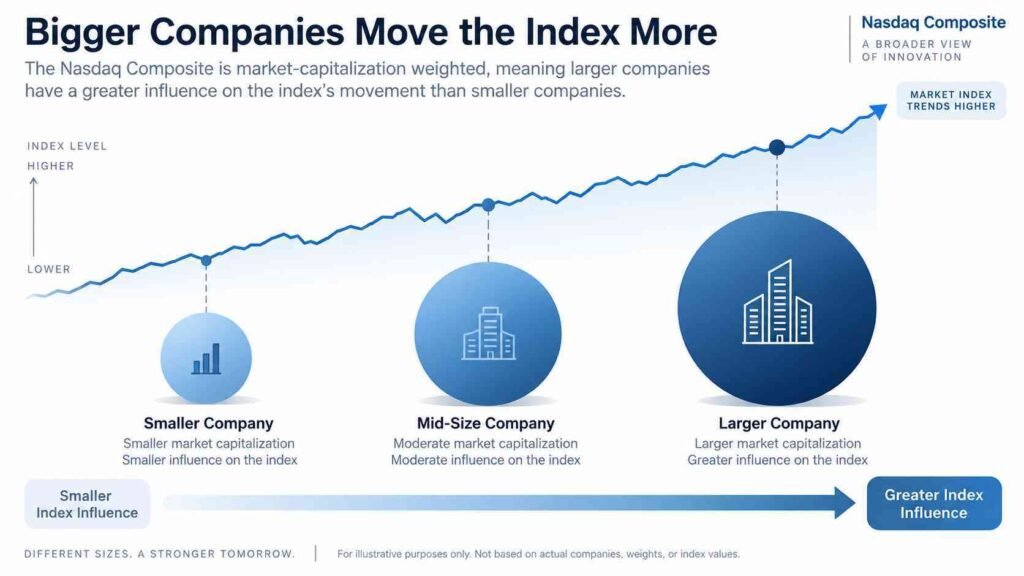
This is an important point when interpreting the index.
The Nasdaq Composite contains thousands of securities, but that does not mean every stock contributes equally to its daily performance. The largest companies can still have a substantial influence because of their size.
For example, a 10% move in a very large company can matter considerably more to the index than a 10% move in a small company.
This market-capitalization approach allows the Composite to reflect changes in the overall value of the Nasdaq-listed equity market while preserving the influence of larger businesses.
Why Technology Has Such a Large Influence
The Nasdaq Composite is strongly associated with technology because technology companies represent a large portion of the index’s market capitalization.
Nasdaq’s March 2026 fact sheet showed technology accounting for about 60.6% of the index’s weight at that time, while consumer discretionary represented about 19.1%. Healthcare, financials, industrials, and other sectors made up much of the remainder. Sector weights change over time as stock prices, company sizes, and index constituents change.
This composition helps explain why the Nasdaq Composite can react strongly to developments affecting technology and growth-oriented companies.
Changes in areas such as semiconductor demand, cloud computing, artificial intelligence, software, consumer technology, interest rates, and corporate earnings can have an outsized effect when many large companies exposed to those themes move together.
Still, it would be inaccurate to describe every movement in the Composite as a technology-market move. The index includes companies across numerous industries, so broader economic and market conditions also matter.
What Does the Nasdaq Composite Tell Investors?
The Nasdaq Composite is useful primarily as a market benchmark.
Because it covers thousands of eligible Nasdaq-listed securities, its performance can provide a broad indication of how that part of the equity market is behaving.
A rising Composite can indicate that the overall value of its constituents is increasing, while a declining index indicates that the combined market values of its constituents are falling, after accounting for the index’s methodology and other adjustments.
However, the index should not be interpreted as a direct measure of the entire U.S. stock market.
The S&P 500, for example, represents a different universe of companies, while the Nasdaq Composite is specifically tied to eligible securities listed on Nasdaq. Its international component and strong technology exposure also give it a distinct market profile.
That makes the Composite most useful when the question is specifically about the Nasdaq-listed equity market.
What Moves the Nasdaq Composite?
The Nasdaq Composite does not move because of one single factor. Its performance reflects the combined effect of price changes across its constituents, with larger companies generally having greater influence.
Several factors can affect the index.
Corporate earnings: Strong or weak earnings from major companies can influence the Composite, particularly when large constituents report results that materially change their market values.
Interest rates: Changes in borrowing costs and expectations for monetary policy can affect how investors value growth-oriented companies. The effect is not always uniform, but rate expectations can be an important market driver.
Technology trends: Developments in semiconductors, artificial intelligence, software, cloud services, and other technology markets can influence many major Nasdaq-listed companies at the same time.
Economic conditions: Consumer spending, employment, inflation, economic growth, and business investment can affect companies across the index.
Market sentiment: Investor expectations can move stock prices before changes in corporate fundamentals become visible in financial results.
Because the Composite includes thousands of companies, these influences can operate simultaneously. A strong performance from large technology companies, for instance, can support the index even if smaller constituents are weaker.
Nasdaq Composite vs. Nasdaq-100
The Nasdaq Composite and Nasdaq-100 share many major constituents, but they are designed for different purposes.
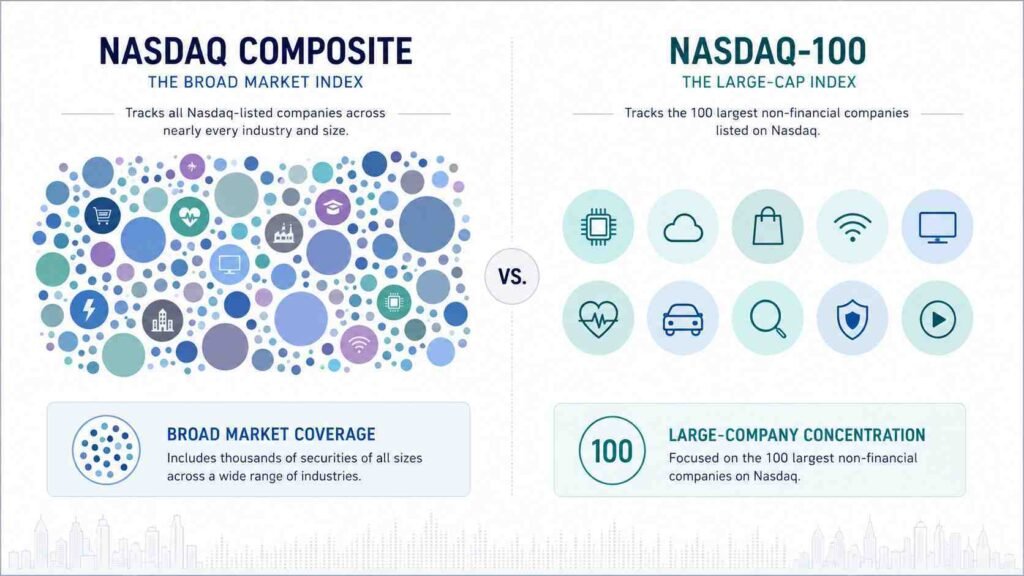
The Composite provides a broad representation of eligible Nasdaq-listed common-type stocks. The Nasdaq-100 focuses on 100 of the largest non-financial companies listed on Nasdaq and uses a modified market-capitalization methodology with additional rules around constituent selection and weighting.
This difference can become particularly noticeable when large companies and smaller Nasdaq-listed businesses perform differently.
If the biggest technology companies rise sharply while smaller companies decline, the Nasdaq-100 may show the strength of those large companies more directly. The broader Composite captures both groups, although its market-capitalization weighting still gives larger companies considerable influence.
Nasdaq Composite vs. S&P 500
The Nasdaq Composite and S&P 500 are both major stock market benchmarks, but they represent different segments of the market.
The S&P 500 is designed to measure a broad segment of large U.S. companies, while the Nasdaq Composite is built around eligible securities listed on the Nasdaq Stock Market.
That means the Composite has a different mix of industries, company sizes, and geographic exposure.
Comparing the two indexes can provide useful context. If the Nasdaq Composite is significantly outperforming the S&P 500, for example, the difference may reflect stronger performance among technology and other Nasdaq-heavy companies rather than a uniform improvement across the broader U.S. equity market.
The indexes answer different questions, so neither should automatically be treated as a replacement for the other.
What Is the Nasdaq Composite Ticker?
The Nasdaq Composite’s price-return index ticker is COMP. Nasdaq also identifies separate tickers for its total-return and net-total-return versions.
This matters when looking up market data because financial platforms may display several Nasdaq-related indexes and products under similar names.
The label “Nasdaq” by itself can also be ambiguous. Financial platforms commonly use Nasdaq-related terminology for the Composite, while many investment products associated with the Nasdaq brand track the Nasdaq-100 instead.
Checking the actual index name or ticker can prevent confusion.
Can You Invest Directly in the Nasdaq Composite?
An index itself is not a stock that investors purchase directly. Instead, investors can use financial products designed to track an index.
There are products linked to the Nasdaq Composite, including the Fidelity Nasdaq Composite Index Tracking ETF (ONEQ), while the Nasdaq-100 has a much larger ecosystem of ETFs and other financial products.
Before investing in any index-tracking product, it is important to check exactly which index it follows. A product described broadly as “Nasdaq” does not necessarily provide exposure to the Nasdaq Composite.
The product’s objective, fees, holdings, tracking approach, and risks can also differ.
What Investors Should Keep in Mind
The Nasdaq Composite can be a useful way to understand the direction of the Nasdaq-listed equity market, but its broad constituent count should not be mistaken for equal exposure across companies.
Because the index is market-cap weighted, its largest constituents can have a disproportionate effect on performance. Its strong technology exposure can also make it particularly sensitive to developments affecting technology and growth-oriented businesses.
At the same time, the index reaches well beyond the biggest technology names. Thousands of smaller companies and businesses from other industries contribute to its overall performance.
That combination of breadth and concentration is central to understanding what the Nasdaq Composite represents.
The Bottom Line
The Nasdaq Composite is a broad stock market index covering thousands of eligible domestic and international common-type securities listed on the Nasdaq Stock Market. Its market-capitalization weighting means larger companies have more influence, while its wide range of constituents gives it a broader scope than the Nasdaq-100.
Its heavy exposure to technology helps explain why it is often used as a barometer for technology and growth-oriented parts of the market, but the index itself is not limited to technology companies.
For investors and market observers, the most useful approach is to understand what the index actually measures before interpreting its daily movement. The Nasdaq Composite offers a broad view of Nasdaq-listed equities, while other benchmarks may be better suited to different parts of the market.
This article is for general informational and educational purposes only and does not constitute financial or investment advice. Market performance can change, and past performance does not guarantee future results.