
The Nasdaq Composite and Nasdaq-100 are two of the most closely watched stock indexes associated with the Nasdaq Stock Market, but they are not interchangeable.
The Nasdaq Composite is a broad index covering thousands of eligible domestic and international common-type stocks listed on Nasdaq. The Nasdaq-100 is much narrower, tracking 100 of the largest Nasdaq-listed non-financial companies under a specific set of eligibility and weighting rules.
That difference affects what each index represents, how companies enter the index, how individual stocks influence performance, and what the indexes are useful for when analyzing the market.
Nasdaq Composite vs. Nasdaq-100 at a Glance
| Feature | Nasdaq Composite | Nasdaq-100 |
|---|---|---|
| What it tracks | Broad group of eligible Nasdaq-listed common-type stocks | 100 of the largest Nasdaq-listed non-financial companies |
| Number of companies | More than 3,000 | 100 |
| Financial companies | Can be included | Excluded |
| Weighting | Market capitalization | Modified market capitalization |
| Selection approach | Broad eligibility based mainly on Nasdaq listing | Rules-based selection from eligible large companies |
| Reconstitution | New eligible listings can enter shortly after listing | Annual reconstitution |
| Rebalancing | Maintained as eligible securities enter or leave | Quarterly |
| Main use | Broad view of the Nasdaq-listed market | Large-cap, non-financial Nasdaq benchmark |
| Symbol | COMP | NDX |
The two indexes overlap considerably because many of the largest Nasdaq-listed companies are included in both. However, their different construction means they can perform differently, particularly when smaller companies, financial stocks, new listings, or the largest constituents behave differently.
What Is the Nasdaq Composite?
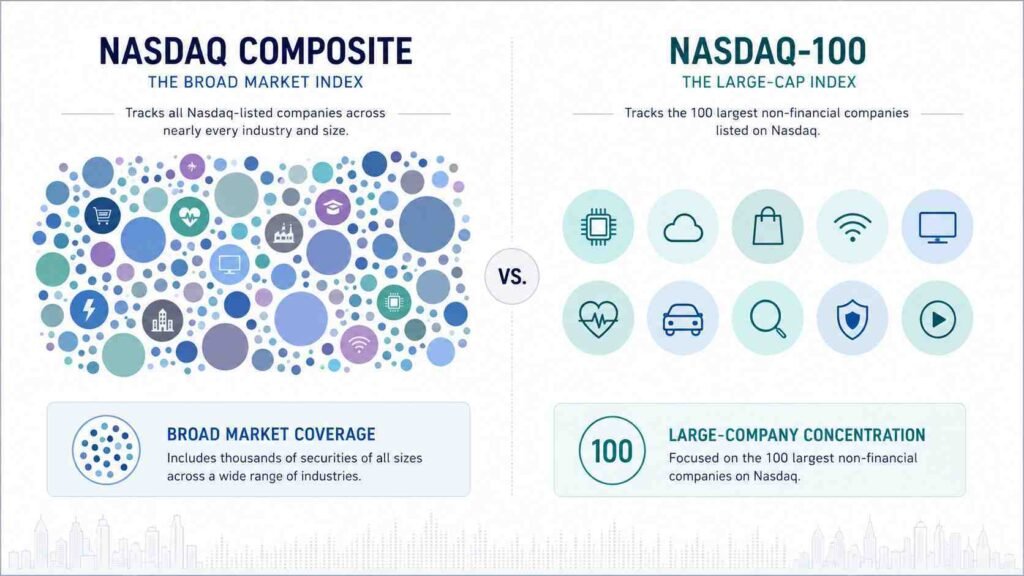
The Nasdaq Composite is designed to measure the performance of eligible domestic and international common-type stocks listed on the Nasdaq Stock Market.
Unlike an index limited to a particular group of large companies, the Composite has a much broader universe. Nasdaq’s current index data shows more than 3,000 components, although the exact number can change as securities become eligible or leave the index.
The index was launched in 1971 and has become one of the most widely followed indicators of the Nasdaq-listed equity market.
Its breadth is one of its defining characteristics. The Composite includes large companies that are also found in the Nasdaq-100, but it also reaches further down the market-capitalization spectrum.
That means the Composite can provide a broader picture of how Nasdaq-listed companies are performing rather than concentrating specifically on the largest non-financial businesses.
How the Nasdaq Composite Is Weighted
The Nasdaq Composite uses a market-capitalization-weighted approach.
In simple terms, companies with larger total market values have a greater influence on the index than smaller companies.
For example, if two companies are both included in the index but one has a substantially larger market capitalization, a similar percentage move in the larger company will generally have a greater effect on the index.
The Composite does not use the same concentration controls and modified weighting structure used by the Nasdaq-100.
This is one reason the two indexes can sometimes produce different results even though they contain many of the same major companies.
What Is the Nasdaq-100?
The Nasdaq-100 tracks 100 of the largest non-financial companies listed on the Nasdaq Stock Market.
It was launched in 1985 and has become an important benchmark for large-cap companies across industries such as technology, consumer discretionary, healthcare, communications, and other parts of the economy.
Despite its strong association with technology, the Nasdaq-100 is not a technology-only index. Its financial exclusion and concentration in large companies can give it a different sector profile from broader market benchmarks, but companies from several industries can qualify.
The index is commonly identified by the ticker NDX.
How Companies Get Into the Nasdaq-100
The Nasdaq-100 is governed by a defined methodology rather than simply including every large company listed on Nasdaq.
Eligible securities must satisfy requirements relating to factors such as their Nasdaq listing, industry classification, liquidity, and other index rules.
The eligible companies are then ranked according to market capitalization, with the largest qualifying companies selected for the index.
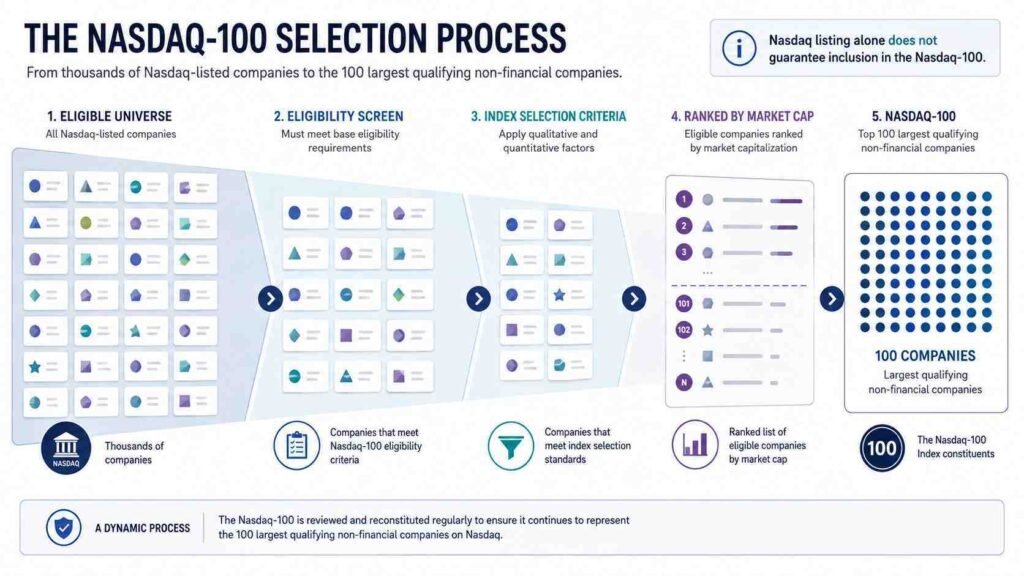
This process creates a very different universe from the Nasdaq Composite.
A company can therefore be part of the Nasdaq Composite without being eligible for the Nasdaq-100. Being listed on Nasdaq alone does not guarantee inclusion in the Nasdaq-100.
The Biggest Difference: Breadth
The easiest way to understand the difference is to think about the two indexes as different-sized lenses.
The Nasdaq Composite is the wider lens. It covers a large portion of the companies listed on Nasdaq.
The Nasdaq-100 is the narrower lens. It focuses on 100 large non-financial companies that meet its eligibility requirements.
This distinction matters because the performance of a broad market can differ from the performance of its largest companies.
Suppose large technology companies rise strongly while smaller Nasdaq-listed companies struggle. The Nasdaq-100 could benefit more from that environment because of its concentration in large companies.
On the other hand, if smaller companies outperform the largest constituents, the broader Nasdaq Composite can capture more of that move.
Nasdaq Composite vs. Nasdaq-100: How Weighting Differs
Both indexes give greater influence to larger companies, but they do not use identical weighting systems.
The Nasdaq Composite uses market capitalization weighting. The Nasdaq-100 uses a modified market-capitalization weighting methodology.
That modification is important because the Nasdaq-100 has rules designed to control concentration and account for factors such as the amount of a company’s shares that are available to investors.
The result is that the largest companies can have substantial influence over the Nasdaq-100, but the index’s methodology places limits on how concentrated that influence can become.
This does not mean the Nasdaq-100 is equally weighted. It is not. Larger companies still generally carry more weight than smaller constituents.
Instead, the methodology attempts to preserve the large-cap character of the index while applying rules around constituent weights and concentration.
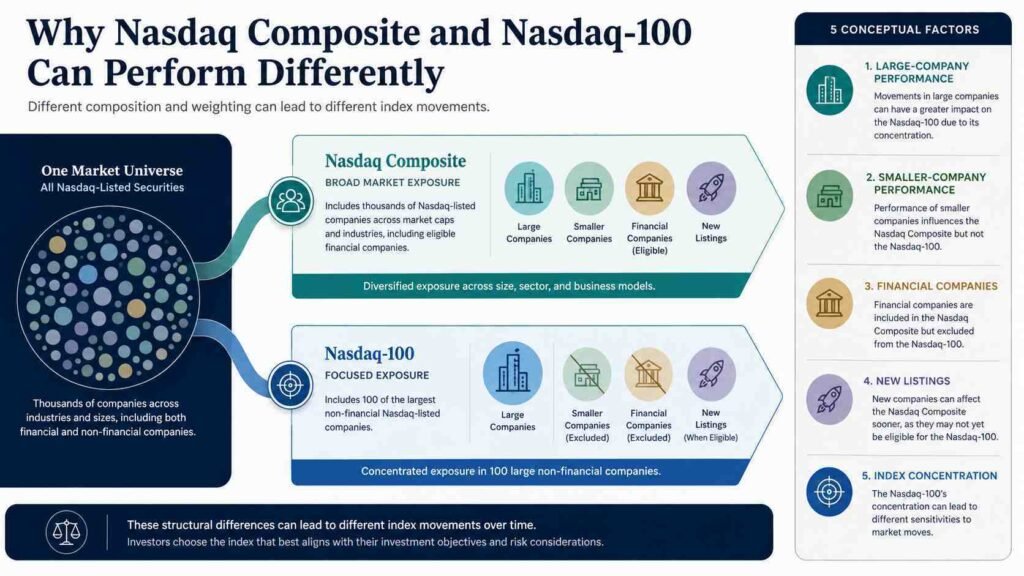
Why the Two Indexes Can Move Differently
Because the indexes are built differently, their daily or yearly performance does not have to be identical.
Several factors can cause them to diverge.
1. Large Companies
The Nasdaq-100 is heavily influenced by the performance of its largest constituents.
When very large companies experience substantial gains or losses, their movements can have a meaningful effect on the index.
The Composite also gives large companies significant influence, but its much larger number of constituents means it includes thousands of companies outside the Nasdaq-100.
2. Smaller Nasdaq-Listed Companies
The Composite captures companies that are not large enough to qualify for the Nasdaq-100.
If smaller Nasdaq-listed companies collectively outperform or underperform large-cap stocks, the difference can show up between the two indexes.
This makes the Composite more useful when the objective is to understand the broader Nasdaq-listed market.
3. Financial Companies
The Nasdaq Composite can include eligible financial companies.
The Nasdaq-100 specifically excludes financial companies.
That creates another source of difference between the two benchmarks.
4. New Listings
The indexes also handle new listings differently.
Eligible securities can enter the Nasdaq Composite relatively quickly after meeting its requirements. The Nasdaq-100, by contrast, has additional eligibility and seasoning requirements and follows its scheduled reconstitution and rebalancing process.
This can matter when a large company enters the Nasdaq market.
A newly listed company may therefore appear in the Composite before it becomes eligible for the Nasdaq-100.
5. Index Concentration
The Nasdaq-100 contains only 100 companies, so its performance is naturally more concentrated.
The Composite spreads its exposure across a much larger number of securities.
That does not mean every company in the Composite has a large influence. Market-capitalization weighting means the biggest companies still account for much of the index’s movement.
But the broader universe creates a different overall exposure.
Is the Nasdaq Composite More Diversified Than the Nasdaq-100?
In terms of the number of constituents, yes.
The Nasdaq Composite contains thousands of eligible stocks, while the Nasdaq-100 contains 100.
But “more diversified” needs some context.
A market-cap-weighted index can still be heavily influenced by its largest companies even when it contains thousands of stocks. The Composite is therefore broader, but that does not mean every constituent has a similar influence.
The Nasdaq-100 is more concentrated by design. Its purpose is not to represent every Nasdaq-listed company. Instead, it provides a benchmark focused on large non-financial companies.
So the better distinction is:
- Nasdaq Composite: broader representation of the Nasdaq-listed market.
- Nasdaq-100: more concentrated exposure to large non-financial Nasdaq-listed companies.
Nasdaq Composite vs. Nasdaq-100 for Market Analysis
The better index depends on the question being asked.
If the goal is to understand the overall performance of companies listed on Nasdaq, the Nasdaq Composite can provide a broader reference point.
If the goal is to track the performance of large non-financial Nasdaq-listed companies, the Nasdaq-100 is more directly aligned with that objective.
This distinction is particularly useful when reading financial news.
A headline may refer to the “Nasdaq” without making clear which index is being discussed. Financial platforms commonly display the Nasdaq Composite under a Nasdaq-related label, while many investment products are designed to track the Nasdaq-100.
Knowing the difference can prevent confusion when comparing an index’s movement with the performance of a portfolio or investment product.
For a broader explanation of Nasdaq market data, including how the Nasdaq indexes are presented and interpreted, see our Nasdaq market data and charts guide.
Which Index Better Represents Technology Stocks?
Neither index is technically a pure technology index.
The Nasdaq Composite contains companies from multiple industries, including technology, healthcare, consumer businesses, financials, and other sectors.
The Nasdaq-100 also covers multiple industries, although its large-company universe has historically resulted in significant exposure to technology and other growth-oriented areas.
This is why the Nasdaq-100 is often discussed as a technology-heavy or growth-oriented benchmark.
However, treating it as simply “the technology index” is misleading.
The actual sector composition changes over time as companies grow, decline, enter, leave, or change classification.
Nasdaq Composite vs. Nasdaq-100: Which Is More Widely Used?
Both are widely followed, but they serve somewhat different purposes.
The Nasdaq Composite is particularly useful as a broad market indicator. Investors and financial media often watch it to gauge the direction of the Nasdaq-listed market.
The Nasdaq-100 has a particularly large ecosystem of financial products built around it, including exchange-traded funds, futures, options, and other products.
That makes the Nasdaq-100 especially important when discussing investment products that specifically seek to track its performance.
The existence of products linked to an index does not make that index inherently better. It simply reflects the different role the benchmark plays in financial markets.
Can You Invest Directly in the Nasdaq Composite or Nasdaq-100?
An index itself is a measurement, not a stock that can be purchased directly.
Instead, investors can use financial products designed to track an index.
There are products linked to both the Nasdaq Composite and Nasdaq-100, although the Nasdaq-100 has a much larger ecosystem of index-linked investment products.
An investor therefore needs to check what an individual fund or other product actually tracks rather than assuming that any product described as “Nasdaq” provides the same exposure.
The distinction is especially important because two products can both reference Nasdaq while tracking different indexes.
Nasdaq Composite vs. Nasdaq-100: Which One Should You Follow?
There is no universal answer because the indexes measure different things.
The Nasdaq Composite may be the more appropriate benchmark when you want a broad view of the Nasdaq-listed equity market.
The Nasdaq-100 may be more appropriate when you want to follow the performance of large non-financial companies listed on Nasdaq.
For investors comparing their own holdings with an index, the most important step is to identify the benchmark actually used by the investment product.
For market analysis, it can also be useful to watch both.
If they move similarly, large companies may be driving much of the broader Nasdaq market’s direction. If they diverge, looking at company size, sector exposure, financial stocks, and the performance of smaller Nasdaq-listed companies can help explain why.
The Bottom Line
The Nasdaq Composite and Nasdaq-100 share many of the same major companies, but they answer different questions.
The Nasdaq Composite is the broader measure, covering thousands of eligible Nasdaq-listed common-type stocks. The Nasdaq-100 is a narrower, rules-based benchmark of 100 large non-financial Nasdaq-listed companies.
Their weighting systems, eligibility requirements, maintenance schedules, and constituent universes are also different.
That is why the Nasdaq Composite and Nasdaq-100 can move in different directions or produce different returns over a particular period, even when many of their largest holdings overlap.
For readers trying to understand a Nasdaq market headline, the key is simple: check which Nasdaq index is actually being referenced. The name “Nasdaq” alone does not tell you what the index contains or how it is constructed.
This article is provided for general informational and educational purposes only and is not financial or investment advice. Index performance can change, and past performance does not guarantee future results.