

Financial services are increasingly becoming part of the products people already use. A customer can pay inside a shopping app, a driver can receive earnings through a transportation platform, or a small business can access financing from the software it uses to manage sales.
These experiences are examples of embedded finance.
Instead of requiring customers to visit a separate bank, payment provider, insurer, or investment platform, financial services can be built directly into a non-financial product or customer journey. The financial service becomes part of the experience rather than a separate destination.
This shift is changing how businesses deliver payments, banking, lending, insurance, cards, and other financial services. It is also creating new opportunities for banks, fintech companies, software platforms, marketplaces, and other businesses.
What Is Embedded Finance?
Embedded finance is the integration of financial services into a non-financial product, platform, application, or customer experience.
The idea is simple: put a financial service where the customer already needs it.
For example, an online marketplace can allow buyers to pay without leaving the marketplace. A business software platform can offer merchants access to working capital. A travel platform can provide insurance during the booking process.
The company offering the overall experience does not necessarily need to become a bank or build an entire financial system itself. Depending on the product and jurisdiction, it can work with banks, payment companies, fintech infrastructure providers, insurers, lenders, and other financial service providers that supply the technology and financial infrastructure behind the experience.
That distinction is important. Embedded finance is primarily about distribution and integration. The financial product is delivered through a platform where customers already spend time.
How Does Embedded Finance Work?
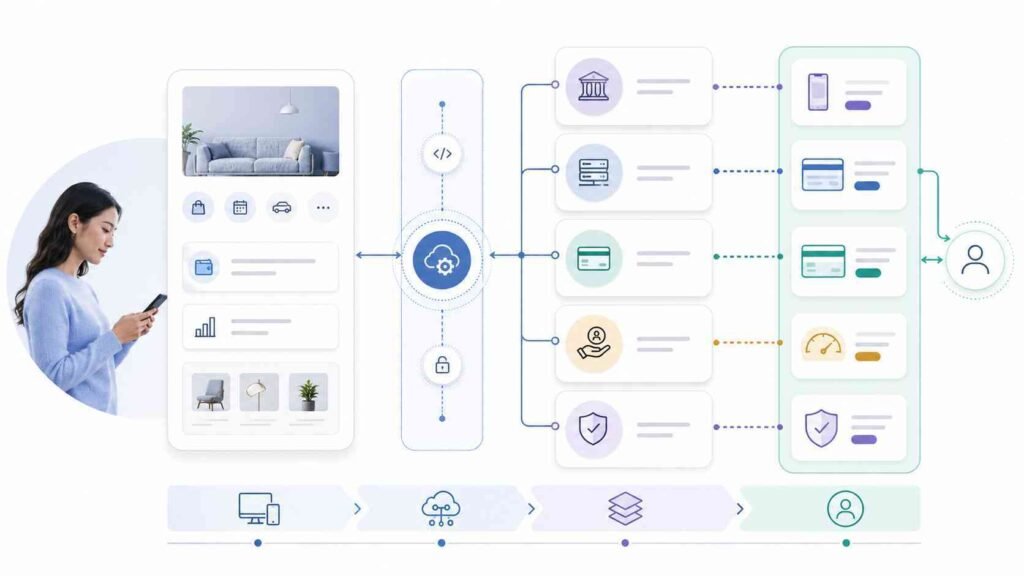
The experience can look simple to the customer, but several layers may operate behind the scenes.
A typical embedded finance arrangement can involve:
- A non-financial business that owns the customer relationship, such as a retailer, marketplace, software company, or mobility platform.
- A financial infrastructure provider that supplies APIs, payment processing, account functionality, card issuing, lending infrastructure, or other capabilities.
- A bank or regulated financial institution where regulated services require a licensed entity.
- Technology and compliance providers supporting identity verification, fraud monitoring, transaction processing, risk controls, reporting, and other functions.
- The end customer, who experiences the financial service as part of the original product.
APIs are often central to this model. They allow different systems to communicate so that a platform can incorporate financial functionality into its own interface.
For the customer, the process might simply look like selecting a payment method, receiving a card, requesting financing, or transferring money.
The underlying infrastructure can be considerably more complicated.
Types of Embedded Finance
Embedded finance is a broad category rather than a single product. Different businesses can embed different financial capabilities depending on what their customers need.

Embedded Payments
Embedded payments allow customers to make or receive payments directly within a platform.
Ride-hailing and delivery applications are familiar examples. Customers can store payment details and complete transactions inside the app instead of handing over cash or being redirected to a separate payment website.
Marketplaces can also use embedded payments to collect money from buyers and distribute funds to sellers.
For businesses, this can make payment collection part of the core workflow rather than a separate process.
Depending on the business model, platforms may also need to manage merchant onboarding, payment settlement, refunds, disputes, and other payment-related responsibilities.
Embedded Banking
Embedded banking brings banking services such as accounts, cards, money movement, and related capabilities into a non-bank platform.
A business software platform, for example, might allow customers to hold funds, receive payments, make transfers, or use a branded business card without requiring them to manage every activity through a traditional banking application.
Embedded banking generally refers specifically to banking-related services, while embedded finance is the broader category that can include banking, payments, lending, insurance, investing, and other financial services.
Embedded Lending
Embedded lending puts financing directly into a customer’s existing purchasing or business workflow.
A customer buying an expensive product might be offered installment financing at checkout. A small business using a marketplace or software platform might receive an offer for working capital based on information already available through that platform.
Buy now, pay later products are one well-known example of embedded lending, although the category extends well beyond consumer checkout financing.
The convenience can be significant, but lending also introduces important considerations around affordability, underwriting, interest, fees, credit risk, and regulation.
Embedded Insurance
Embedded insurance integrates insurance into the purchase or service where the need for coverage arises.
A travel platform might offer travel protection during booking. A customer purchasing a product could be offered coverage for certain risks associated with that purchase.
The defining feature is not the insurance product itself. It is the way the product is incorporated into another customer journey.
Embedded Investing
Investment functionality can also be integrated into non-traditional financial platforms.
For example, a personal-finance app might allow users to access investment products from within the same interface they use to manage savings and cash balances.
Because investing involves financial risk, these products may be subject to specific disclosure, licensing, suitability, and other regulatory requirements depending on the product and jurisdiction. Platforms also need to communicate investment risks and potential losses clearly.
Embedded Cards and Wallets
Businesses can also provide branded cards or digital wallets within their platforms.
A marketplace might provide a payment card to sellers. A gig-economy platform could provide a card that allows workers to access earnings or manage business-related spending.
The card may carry the platform’s branding, but the underlying issuing and payment infrastructure can come from specialized financial providers and banking partners.
Embedded Finance Examples
The easiest way to understand embedded finance is to look at where it appears in everyday business models.

E-commerce
Online retailers can combine payments, financing, wallets, rewards, and insurance with the shopping experience.
Instead of completing the purchase and then searching for a financial product elsewhere, the customer can access relevant services during checkout or through the retailer’s account.
Marketplaces
Marketplaces have particularly strong reasons to use embedded financial services because they often manage money between multiple parties.
A marketplace may need to collect payments from customers, distribute money to sellers, handle refunds, provide seller accounts, or offer financing.
Embedding these functions can make the platform more useful to both sides of the marketplace.
Software for Small Businesses
Accounting, point-of-sale, payroll, invoicing, and business-management software can incorporate financial services directly into workflows.
A merchant already using software to manage sales may also need payment acceptance, a business account, a card, or access to financing.
Embedding those services can reduce the need to move between several systems.
Transportation and Delivery Platforms
Mobility and delivery platforms can combine payments, driver cards, payouts, and other financial services within the same ecosystem.
For drivers and other workers, faster access to earnings can be particularly relevant because the platform is already where they track work and income.
Travel
Travel platforms can combine bookings with payments, foreign-currency services, financing, and insurance.
The financial product becomes connected to the specific transaction instead of being offered as a separate service.
Business-to-Business Platforms
Embedded finance is not limited to consumers.
Business platforms can incorporate payment collection, accounts payable, accounts receivable, expense management, cards, payroll, and financing.
This can be especially useful when financial tasks are closely connected to the software’s main function.
What Are Embedded Finance Solutions?
Embedded finance solutions are the technology, infrastructure, and financial capabilities that allow a business to integrate financial services into its own product.
Depending on the use case, a solution can include:
- Payment processing
- Account infrastructure
- Card issuing
- Money transfers
- Payouts
- Lending infrastructure
- Insurance integration
- Digital wallets
- Financial data connectivity
- Identity verification
- Fraud prevention
- Compliance tools
- Transaction and ledger infrastructure
A business does not necessarily need every component. The appropriate solution depends on what financial service it wants to provide and which responsibilities it plans to manage itself.
For example, a company that only wants to add payments may need a very different infrastructure stack from a software platform that wants to provide accounts, cards, lending, and money movement.
Who Provides Embedded Finance?
The embedded finance ecosystem includes several types of companies rather than one universal provider.
Banks
Banks can provide the regulated infrastructure behind certain embedded financial products and can work with technology companies and platforms to distribute those products.
Fintech Infrastructure Companies
Fintech infrastructure providers can offer APIs and technology that make it easier for businesses to incorporate financial functionality.
Some specialize in payments, while others focus on banking infrastructure, card issuing, lending, compliance, or other areas.
Banking-as-a-Service Providers
Banking-as-a-Service, often abbreviated as BaaS, allows businesses to access banking capabilities through technology and partnerships with regulated institutions.
BaaS and embedded finance are closely related, but they are not identical terms. BaaS generally describes the infrastructure or service model that provides banking capabilities, while embedded finance describes the broader customer-facing integration of financial services into non-financial products.
Payment and Card Providers
Payment processors, payment facilitators, card networks, and card-issuing platforms can supply important parts of an embedded finance stack.
Lenders and Insurers
Specialized lenders and insurers can provide the underlying financial products that platforms integrate into their customer experiences.
The result is an ecosystem in which the customer may interact with one brand while several financial and technology providers operate behind the scenes.
Embedded Finance vs. Embedded Banking
The terms are sometimes used interchangeably, but there is a useful distinction.
Embedded finance is the broader concept. It can include:
- Payments
- Banking
- Lending
- Insurance
- Investing
- Cards
- Wallets
- Other financial services
Embedded banking focuses more specifically on banking-related products such as accounts, cards, deposits, and money movement.
In other words, embedded banking can be considered one part of the larger embedded finance category.
This distinction becomes useful when evaluating companies and products. A platform offering merchant accounts and cards may be providing embedded banking, while a platform offering payments, insurance, and financing may be using a broader embedded finance model.
Embedded Finance vs. Traditional Financial Services
Traditional financial services generally require customers to interact directly with a financial institution.
Someone looking for a loan might visit a bank. Someone buying insurance might contact an insurer. Someone opening an investment account might use a brokerage platform.
Embedded finance changes the point of interaction.
The financial service is presented within another activity that the customer is already performing.
That does not mean traditional financial institutions disappear. In many embedded finance models, banks, lenders, insurers, payment companies, and other regulated institutions remain essential behind the scenes.
What changes is where the customer encounters the financial product.

Why Businesses Use Embedded Finance
There are several reasons companies are incorporating financial services into their products.
Better Customer Experience
Customers generally prefer fewer unnecessary steps.
A payment, financing option, account, or insurance product that appears at the appropriate point in a workflow can reduce friction.
More Revenue Opportunities
Financial services can create additional sources of revenue for businesses, depending on the business model and arrangements with financial partners.
For software companies and marketplaces, this can create a way to expand beyond their original product.
Greater Customer Retention
Financial tools can make a platform more deeply connected to a customer’s daily activities.
For example, a business platform that handles payments, accounts, cards, and financial management may become more difficult for a customer to replace than a platform that only provides one basic function.
More Relevant Financial Products
Embedded finance can make financial services more contextual.
A financing offer presented when a customer is making a purchase is connected to an immediate need. A working-capital offer presented inside business software is connected to the business activity taking place there.
That does not automatically make the product better or cheaper, but it can make the timing more relevant.
The Risks and Challenges of Embedded Finance
The convenience of embedded finance does not eliminate the responsibilities associated with financial services.
Regulation and Compliance
Financial products are subject to laws and regulatory requirements that vary by product and jurisdiction.
Regulatory responsibilities can also differ significantly by country, product, and business model, so an embedded finance structure that works in one market may not work the same way in another.
Businesses need to understand which party is responsible for activities such as customer identification, disclosures, transaction monitoring, consumer protection, and reporting.
Fraud and Security
More financial activity inside digital platforms can create additional opportunities for fraud and account abuse.
Strong identity verification, transaction monitoring, authentication, cybersecurity, and fraud controls are therefore important parts of an embedded finance system.
Data and Privacy
Financial services involve sensitive information.
Companies need appropriate controls for collecting, storing, processing, and sharing financial and personal data. Customers should also understand how their information is being used.
Third-Party Dependence
A company that relies on financial infrastructure providers may become dependent on those providers for important parts of its product.
Changes to pricing, availability, compliance requirements, technology, or banking relationships can affect the platform using the service.
Financial Risk
Embedding credit or other financial products can introduce risks that did not previously exist within a business.
A company moving into lending, for example, has to consider underwriting, repayment behavior, credit losses, regulatory obligations, and customer outcomes.
This is one reason embedded finance should not be treated simply as another software feature.
Is Embedded Finance the Same as Fintech?
No.
Fintech is a broad term covering the use of technology to create, improve, or deliver financial products and services.
Embedded finance is a particular way of delivering financial services by integrating them into non-financial products or experiences.
A fintech company can build the infrastructure that enables embedded finance, while a non-financial company can use that infrastructure to offer financial services to its customers.
The two concepts overlap, but they describe different things.
What Is the Future of Embedded Finance?
The development of embedded finance is likely to continue as businesses look for ways to make financial tasks part of existing digital workflows.
The most interesting changes may not always be obvious to customers. Instead of launching another standalone financial application, companies can increasingly make payments, accounts, financing, payouts, insurance, and other services part of the software people already use.
For businesses, that creates an opportunity to move closer to customers’ financial activity.
For banks and other financial institutions, it creates new distribution channels but also raises questions about customer ownership, economics, regulation, technology, and risk management.
The long-term direction will therefore depend on more than technology. Regulation, consumer protection, security, economics, and the quality of the underlying financial infrastructure will all influence how embedded finance develops.
Key Takeaway
Embedded finance brings financial services into the products and platforms people already use.
Its most visible examples include in-app payments, checkout financing, branded cards, business accounts, insurance at the point of purchase, and financial tools built into business software.
The important idea is not simply that financial services are becoming digital. Many financial services were already digital. The bigger change is that financial functionality is becoming integrated into non-financial experiences.
For customers, that can mean fewer steps and more convenient access. For businesses, it can create new products, revenue opportunities, and deeper relationships with users. But the model also brings regulatory, security, privacy, operational, and financial risks that cannot be treated as an afterthought.
As embedded finance develops, the companies most likely to benefit will be those that combine convenience with responsible financial-product design, reliable infrastructure, and strong customer protections.
Disclaimer: This article is provided for general informational and educational purposes only. It is not financial, investment, legal, tax, or other professional advice. Financial products and services involve risks, and readers should consider their individual circumstances and seek qualified professional advice where appropriate.