The Nasdaq-100 is a stock market index that tracks 100 of the largest non-financial companies listed on Nasdaq. Although it is widely associated with technology, the index covers companies across several industries and is built around a specific set of eligibility, selection, and weighting rules.
The Nasdaq-100 is one of the major benchmarks within the Nasdaq market, but it does not simply represent the 100 largest companies on the exchange. Companies must first meet the index’s eligibility requirements, while separate rules determine how constituents are selected and how much influence each one has on the index.
That distinction is important when interpreting the Nasdaq-100. Its performance reflects not only the direction of its constituents, but also the concentration created by its modified market-capitalization weighting methodology.
What Is the Nasdaq-100?
The Nasdaq-100 is designed to measure the performance of 100 of the largest Nasdaq-listed non-financial companies that meet the index’s eligibility requirements.
The index includes U.S. and international companies, provided they satisfy the applicable listing and other requirements. Its official ticker is NDX, and it uses a modified market-capitalization weighting methodology.
The Nasdaq-100 is different from the Nasdaq Composite, which covers a much broader range of eligible securities listed on Nasdaq. The Nasdaq-100 is narrower and more concentrated by design.
This concentration has a practical effect on index analysis. Because larger constituents generally receive larger weights, the performance of the Nasdaq-100 can be influenced substantially by its biggest companies rather than being evenly distributed across all 100 constituents.
How Does the Nasdaq-100 Work?
The Nasdaq-100 follows a rules-based process for determining which companies qualify, which companies are selected, and how their weights are calculated.
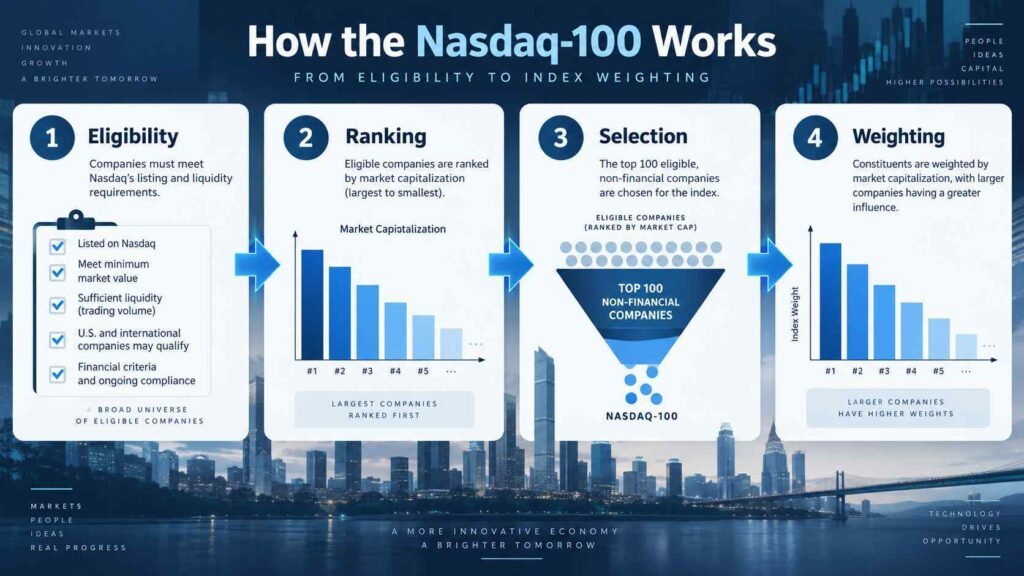
At a high level, the process works through four stages:
- Eligibility: A company must satisfy the index’s listing, industry, liquidity, and other requirements.
- Ranking: Eligible companies are ranked using the market-capitalization measure specified by the methodology.
- Selection: The index’s reconstitution rules determine which companies become constituents.
- Weighting: Selected constituents receive weights based on Modified Market Capitalization, subject to concentration limits.
These stages should not be treated as interchangeable.
Selection determines who is in the index. Weighting determines how much each constituent matters once it is included.
That distinction is particularly useful when analyzing the index. A company can qualify for inclusion because of its market capitalization ranking, but its eventual influence on index performance depends on the separate weighting methodology and the limits applied to the largest constituents.
Which Companies Can Be Included in the Nasdaq-100?
Market capitalization is important, but size alone does not make a company eligible for the Nasdaq-100.
Nasdaq Listing Requirements
A company must be primarily listed on a qualifying U.S. Nasdaq-affiliated exchange. The Nasdaq Capital Market is excluded from the eligible listing venues.
Eligible securities can include common stocks, tracking stocks, and certain American Depositary Receipts (ADRs), including New York Registry Shares.
Companies with multiple classes of eligible securities can also be considered under the methodology’s rules governing multiple security classes.
The listing requirement establishes the universe from which the index can select companies. Only after that universe has been defined does the ranking and selection process determine which companies qualify for the final index.
Financial Companies Are Excluded
The Nasdaq-100 excludes companies classified in the Financial Industry under the Industry Classification Benchmark, or ICB.
This is one of the index’s defining characteristics. A large financial institution can therefore be listed on Nasdaq and still be excluded from the Nasdaq-100 because of its industry classification.
Companies in the Real Estate Industry can qualify when they meet the relevant requirements and are not organized as real estate investment trusts, or REITs.
This is also why describing the Nasdaq-100 simply as a “top 100 Nasdaq companies” index can be misleading. The methodology applies a specific definition of the companies that belong in its eligible universe.
Liquidity Matters
Eligible securities must generally have a three-month average daily value traded of at least $5 million.
The liquidity requirement adds another layer beyond company size. A company may have a large market capitalization, but the index methodology still requires sufficient trading activity for eligibility.
From a market-structure perspective, this helps ensure that the securities entering the index have an established level of trading activity rather than being selected on size alone.
Listing History
Companies generally need to have been listed and available for trading for at least three full calendar months, excluding the month of their initial listing.
There are separate provisions for certain newly listed companies that qualify under the Fast Entry rules.
Other Exclusions
The methodology excludes several types of securities, including REITs, SPACs, and when-issued securities.
Companies involved in bankruptcy proceedings or certain transactions expected to cause them to become ineligible can also be excluded from initial inclusion.
These requirements mean that the Nasdaq-100 selection process begins with a filtered universe rather than every security traded on Nasdaq.
How Are Companies Selected for the Nasdaq-100?
Once the eligible universe has been established, companies are ranked using Full Market Capitalization.
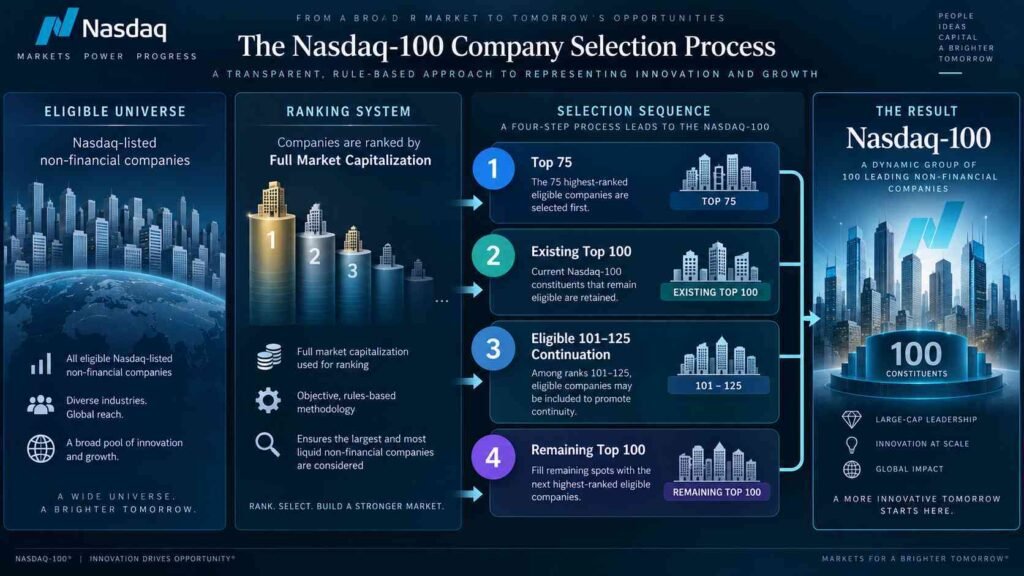
This is an important distinction because Full Market Capitalization is used for the selection process, while a separate Modified Market Capitalization measure is used when determining index weights.
Under the current methodology, Full Market Capitalization can consider both listed and unlisted shares for certain companies, including direct listings and companies represented by Primary ADRs. Non-Primary ADRs receive different treatment based on their listed depositary shares.
The December Reconstitution
The main selection process takes place during the annual December reconstitution.
The methodology generally follows a defined sequence:
- The top 75 eligible companies by Full Market Capitalization are selected.
- Existing constituents ranked within the top 100 are retained.
- Certain existing constituents ranked from 101 through 125 may be retained under the methodology’s continuation rules.
- Other eligible companies ranked within the top 100 are selected until the index reaches 100 constituents.
The use of continuation rules is significant because it reduces unnecessary turnover. A constituent does not automatically disappear from the index simply because its ranking moves slightly below the top 100.
From an index-analysis perspective, this creates a degree of continuity between annual reconstitutions while still allowing the index to reflect changes in relative company size.
How Is the Nasdaq-100 Weighted?
After selection comes another distinct part of the methodology: weighting.
The Nasdaq-100 uses modified market-capitalization weighting, so larger constituents generally have a greater influence on index performance than smaller ones.
However, the index is not simply a proportional ranking of companies by market value.
For weighting purposes, the methodology uses Modified Market Capitalization, which considers eligible listed shares and applies additional adjustments and concentration limits.
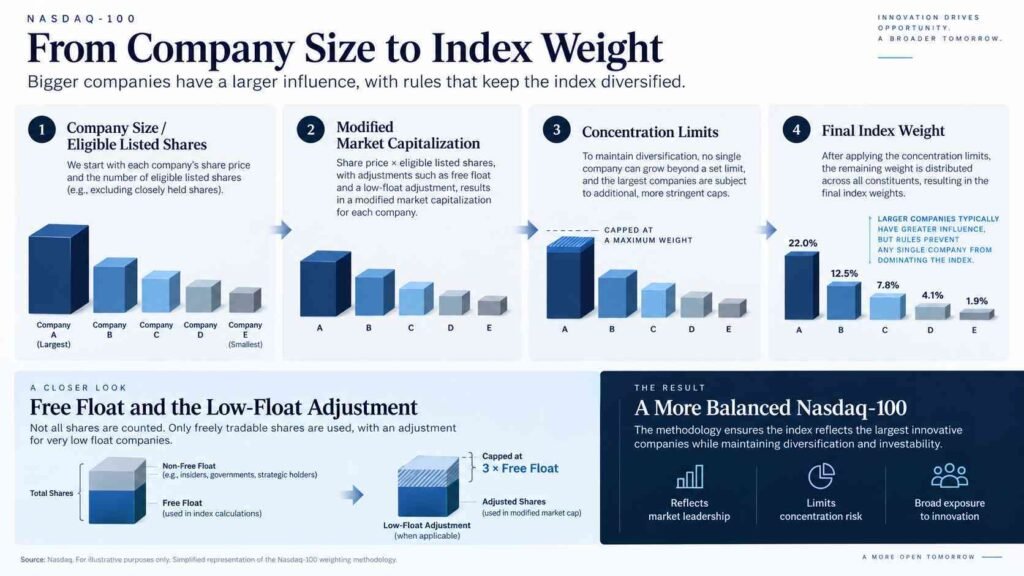
Foreign-listed and unlisted shares are disregarded when calculating the Modified Market Capitalization used for index weighting.
The practical effect is that a company’s overall corporate size and its actual eligible listed share base do not necessarily translate into an unlimited index weight.
Why the Weighting Method Matters
The weighting methodology is one of the most important factors to understand when interpreting Nasdaq-100 performance.
Suppose two constituents each rise by the same percentage during a trading session. The larger-weighted company will generally have a greater effect on the index’s return.
This means the Nasdaq-100’s headline performance can be driven disproportionately by its largest constituents.
The methodology therefore combines market-capitalization exposure with concentration controls rather than allowing the largest companies to determine their weights without limits.
How Does Free Float Affect Nasdaq-100 Weighting?
Free float broadly represents the portion of a company’s shares that is available for public trading.
This matters because total shares outstanding do not always reflect the amount of equity that is actually available to public investors. A company may have a large total share count while a relatively small proportion is freely tradable.
The Nasdaq-100 does not impose a minimum free-float requirement for eligibility. However, the methodology applies special treatment to securities with relatively low public float.
Under the current rules, the total shares outstanding used for a low-float security can be capped at three times its free-floating shares when calculating Modified Market Capitalization.
The purpose is to prevent a relatively small publicly tradable share base from producing an outsized weighting effect.
This is a good example of why index construction cannot be understood through market capitalization alone. The methodology also considers how much of that equity is actually available in the market when determining its influence.
How Often Does the Nasdaq-100 Change?
The Nasdaq-100 is maintained throughout the year rather than being rebuilt only once annually.
The index has an annual December reconstitution and scheduled quarterly rebalances during the year.
The annual reconstitution is primarily concerned with determining which eligible companies should make up the index based on the selection rules.
The scheduled rebalances provide a mechanism for adjusting index shares and responding to changes in market capitalization, shares outstanding, float-related factors, and other circumstances covered by the methodology.
During the March, June, and September rebalances, constituents ranked outside the top 125 can be removed under the applicable rules. If the number of constituents falls below 100, eligible companies can be added according to the methodology.
The December event combines the annual reconstitution with the scheduled rebalance.
This maintenance process matters because the Nasdaq-100 is intended to remain representative of its defined universe over time. Without periodic adjustments, changes in company size, share structure, and eligibility could gradually make the index less aligned with its methodology.
What Changed in the Nasdaq-100 Methodology in 2026?
Nasdaq introduced targeted changes to the Nasdaq-100 methodology effective May 1, 2026.
The core purpose of the index remained unchanged: it continues to represent 100 of the largest eligible non-financial companies listed on Nasdaq.
The changes mainly affected how companies are evaluated and how the index responds to major changes in its eligible universe.
Listed and Unlisted Shares
Under the updated methodology, listed and unlisted shares can be considered when determining Full Market Capitalization for eligibility and ranking in applicable cases.
Weighting remains based on eligible listed shares.
This distinction is important because it separates the question of how large a company is for selection purposes from how much of that company should influence the index once selected.
Fast Entry
The 2026 methodology introduced Fast Entry, which provides an expedited route for certain very large companies that are not already Nasdaq-100 constituents.
A non-constituent can qualify for Fast Entry when its Full Market Capitalization ranks within the top 40 of current Nasdaq-100 constituents and it satisfies the other eligibility requirements.
Fast Entry does not necessarily require an immediate removal of another constituent. As a result, the index can temporarily contain more than 100 companies during certain transitions.
The provision is particularly relevant for very large new listings because waiting for the normal annual reconstitution could otherwise leave a major eligible company outside the index for an extended period.
Low-Float Treatment
The 2026 changes also revised the treatment of securities with relatively low public float.
Rather than relying on the previous minimum-float framework, the updated methodology introduced a more graduated approach to float-related treatment, with the weighting calculation ultimately applying the three-times-free-float cap.
This change affects how a company’s available public shares translate into its potential index weight without changing the basic market-capitalization foundation of the index.
Why Is the Nasdaq-100 So Technology-Heavy?
The Nasdaq-100 is frequently described as a technology-focused index, but technology is not an eligibility requirement.
Its technology-heavy character is largely the result of the companies that make up the eligible Nasdaq universe and the large market capitalizations achieved by many technology and technology-related businesses.
The modified market-capitalization methodology reinforces that exposure. When large technology companies have significantly greater market values than many other constituents, they can receive correspondingly larger weights and therefore have a greater effect on index performance.
This distinction matters when analyzing the index. A technology-heavy outcome does not mean the methodology is designed to select technology companies. It means the index’s rules, applied to the Nasdaq-listed non-financial universe, produce substantial exposure to companies in that sector and related industries.
The Nasdaq-100 also includes companies from areas such as consumer discretionary, healthcare, communications, and industrials.
Nasdaq-100 vs. Nasdaq Composite
The Nasdaq-100 and Nasdaq Composite represent different segments of the Nasdaq-listed market.
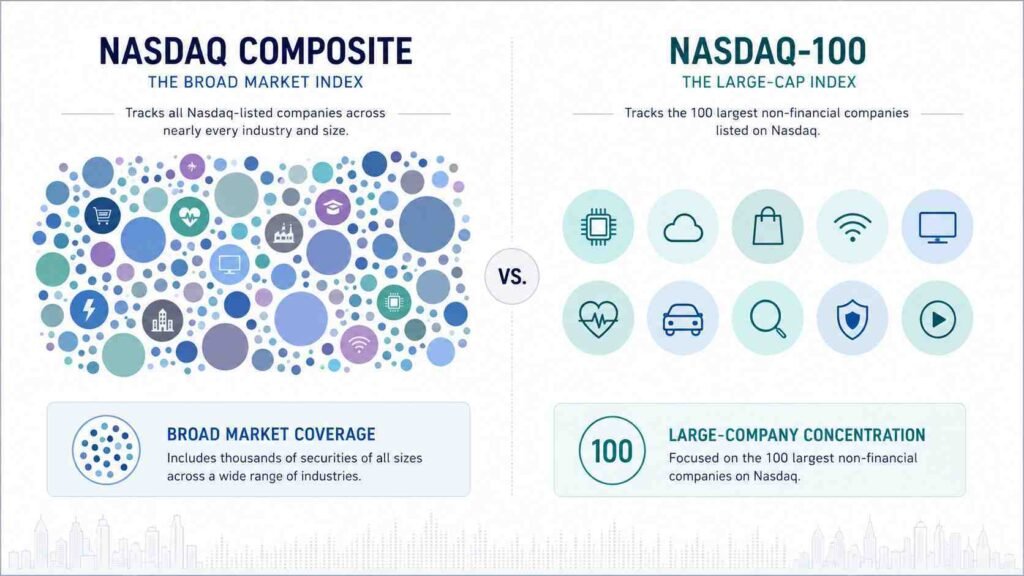
The Nasdaq-100 focuses on large non-financial companies that satisfy its eligibility requirements, while the Nasdaq Composite has a much broader coverage of eligible Nasdaq-listed securities.
The difference in breadth leads to different levels of concentration and different exposure to individual companies and sectors.
For market analysis, this distinction is useful because the two indexes can respond differently to the same market environment. A move in a large Nasdaq-100 constituent, for example, can have a much more visible effect on the Nasdaq-100 than on a broader index containing thousands of securities.
What Is the Nasdaq-100 Ticker?
The official ticker for the Nasdaq-100 is NDX.
NDX represents the index itself. It is not the ticker of an individual company or an exchange-traded fund.
Financial products can be structured to track the Nasdaq-100, but those products are separate from the index. Their fees, structure, tracking differences, tax treatment, and other characteristics can affect their performance relative to the underlying benchmark.
How Can Investors Get Exposure to the Nasdaq-100?
An index itself is not purchased directly.
Investors can obtain exposure through financial products designed to track or reference the Nasdaq-100, including exchange-traded funds.
One well-known example is the Invesco QQQ ETF, which tracks the Nasdaq-100.
The distinction between the index and an investment product is important. Tracking the same benchmark does not necessarily mean two products will deliver identical results after fees, expenses, trading costs, and other factors.
Investors should therefore evaluate the characteristics and risks of the specific product rather than treating the Nasdaq-100 index and an investment vehicle as the same thing.
Key Takeaways
The Nasdaq-100 is a rules-based benchmark built around a specific definition of large, non-financial Nasdaq-listed companies.
The most important points are:
- The index tracks 100 of the largest eligible non-financial companies listed on Nasdaq.
- NDX is the official ticker for the index.
- Companies must satisfy listing, industry classification, liquidity, seasoning, and other eligibility requirements.
- Full Market Capitalization is used in the selection process.
- Modified Market Capitalization determines constituent weights.
- Selection and weighting are separate parts of the methodology.
- Free-float treatment can limit the weighting influence of low-float securities.
- The index undergoes an annual December reconstitution and scheduled quarterly rebalances.
- The 2026 methodology introduced changes including Fast Entry and revised treatment of listed, unlisted, and low-float shares.
- The Nasdaq-100 is technology-heavy because of the composition and market capitalization of companies in its eligible universe, not because it is formally a technology index.
- Investors can obtain exposure through financial products that track the index, but those products are separate from NDX.
The Nasdaq-100 is therefore best understood as more than a list of 100 large Nasdaq companies. Its eligibility, selection, weighting, and maintenance rules collectively determine what the index represents and how individual constituents influence its performance.
This article is provided for general informational and educational purposes only and should not be considered financial or investment advice. Investors should consider their own circumstances, objectives, and risk tolerance and conduct appropriate research before making investment decisions.