

SaaS platforms have traditionally made money by charging for access to software. But as software becomes more competitive and customers expect more of their business operations to happen in one place, that model is evolving.
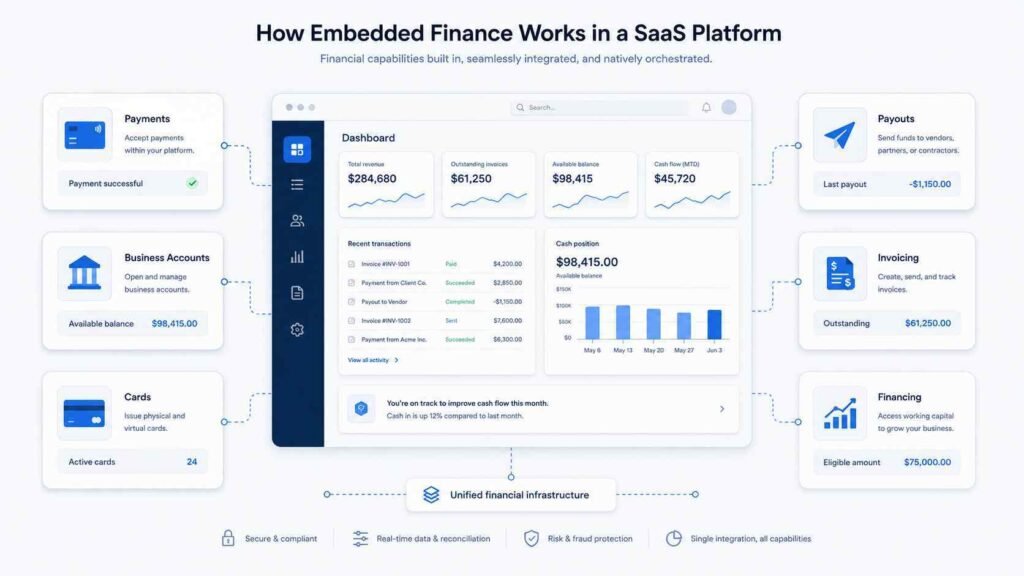
Embedded finance gives SaaS companies a way to build financial services directly into the workflows customers already use. Payments, accounts, cards, payouts, financing, and other financial capabilities can become part of the software rather than sending users to separate financial providers.
The benefits of embedded finance for SaaS platforms go beyond adding another feature. Done well, it can make the product more useful, create additional revenue opportunities, improve the customer experience, and deepen the relationship between a platform and its users.
What Is Embedded Finance for SaaS Platforms?
Embedded finance refers to financial products or services integrated directly into a non-financial software product.
For a SaaS platform, that could mean allowing customers to:
- Accept payments without leaving the platform
- Send payouts to employees, contractors, or suppliers
- Create or manage business accounts
- Issue physical or virtual cards
- Access financing within the software
- Manage invoices and payment workflows
- Move money between accounts
- Use financial tools connected to their existing business data
The important distinction is that these services are built into the customer’s normal software experience.
Instead of using one application for business management, another for payments, another for banking, and another for financing, a customer may be able to complete several of these tasks within the SaaS platform they already use.
This model is particularly relevant to vertical SaaS companies serving specific industries. A restaurant management platform, for example, may integrate payments and payouts, while an accounting platform might provide financial accounts or financing alongside its core bookkeeping functionality.
Why Are SaaS Platforms Turning to Embedded Finance?
SaaS businesses face a familiar challenge: subscription software can be easy to compare and, in many categories, relatively easy to replace.
A competitor may offer similar features at a comparable price. If customers have to leave the platform to handle important financial tasks, much of their business activity remains outside the software.
Embedded finance changes that relationship.
When financial activity becomes part of the product, the platform can move from being simply a place where customers manage information to becoming part of how they actually run their business.
That can create several advantages.
1. New Revenue Streams Beyond Subscriptions
One of the clearest benefits is the potential to generate revenue beyond recurring software fees.
Depending on the product and its financial partners, a SaaS platform may be able to generate revenue from payment activity, card usage, financial accounts, or other embedded services.
This creates a different revenue relationship with customers.
A traditional SaaS company might earn roughly the same subscription amount regardless of how heavily a customer uses the platform. With embedded financial services, revenue can potentially grow alongside the customer’s financial activity.
For example, a business management platform charging a monthly subscription could also facilitate customer payments. As customers process more transactions through the platform, the platform may have additional opportunities to monetize that activity.
That does not mean embedded finance automatically produces higher profits. Transaction costs, fraud, compliance, infrastructure, partner fees, and operational requirements all affect the economics. The business case needs to be evaluated on the actual financial model rather than the headline revenue opportunity.
2. Stronger Customer Retention
Customer retention is one of the most important benefits of embedded finance for SaaS platforms.
Software becomes harder to replace when customers depend on it for more than one isolated task.
Consider a small business using a SaaS platform to manage customers, invoices, payments, payouts, and financial records. Moving to another provider could involve changing several connected workflows rather than simply replacing a piece of software.
This creates what can be described as workflow stickiness.
The value does not come from deliberately making customers difficult to leave. It comes from solving more of their everyday problems within one product.
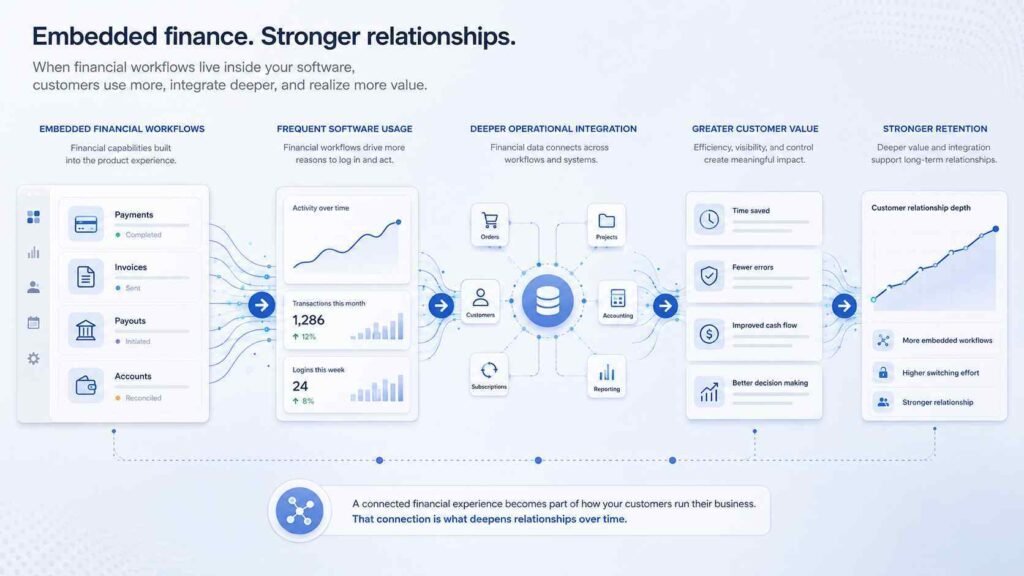
How embedded finance customer retention works in SaaS
The connection can be understood through a simple chain:
More useful financial workflows → more frequent product usage → deeper operational dependence → greater customer value → potentially stronger retention
For example, a SaaS platform that only provides reporting may be useful once or twice a week. If the same platform also handles payments and payouts, customers may interact with it throughout the day.
That increased importance can make the platform more central to the customer’s operations.
However, embedded finance should not be treated as a guaranteed churn-reduction strategy. Customers can still leave if the financial product is expensive, unreliable, difficult to use, or poorly integrated.
3. A Better Customer Experience
Financial tasks are often closely connected to the activities customers are already performing inside SaaS products.
Separating those tasks can create unnecessary friction.
Imagine a property management platform where a user manages tenants, tracks rent, and creates invoices. If the user then has to leave the platform to collect payments and reconcile transactions, the workflow becomes fragmented.
An embedded payment system can keep those activities connected.
The same principle applies across industries:
- A marketplace can integrate seller payouts.
- An accounting platform can connect payment collection with invoices.
- A field-service platform can combine job management with customer payments.
- A restaurant platform can integrate payments with its operational software.
- A business management platform can connect spending tools with financial records.
The result is not simply “more fintech.” It is fewer disconnected steps for the customer.
4. Greater Product Value
Embedded financial services can expand what a SaaS platform actually does for its customers.
A software product that originally solved one business problem can gradually become a broader operating platform.
For example, an accounting product could move beyond recording financial activity and help customers collect payments, manage business funds, or access relevant financial products.
This can be particularly valuable for vertical SaaS.
A vertical platform already understands the workflows and terminology of a specific industry. Financial services can then be designed around those workflows instead of being offered as generic products disconnected from the customer’s day-to-day work.
That context can make financial services more useful and easier to access.
5. More Frequent Customer Engagement
Subscription software does not always require frequent interaction.
Embedded finance can change that by connecting the platform to events that naturally occur throughout a business day.
Payments, payouts, card transactions, invoices, transfers, and financial reporting can all bring customers back to the product.
More frequent engagement does not automatically mean better retention. The activity has to provide genuine value. But when financial functionality solves real problems, it can increase the platform’s relevance in everyday operations.
This is one reason embedded payments are increasingly being viewed as a strategic capability rather than simply an add-on feature for SaaS businesses.
6. Better Opportunities for Cross-Selling
Once a SaaS platform understands the financial workflows surrounding its core product, it may be able to introduce additional services that genuinely fit customer needs.
For example, a platform could potentially offer:
- Payment processing
- Business accounts
- Expense cards
- Financing
- Automated payouts
- Currency-related services
- Financial reporting tools
The key is relevance.
A SaaS platform should not add financial products simply because they are available. The service should solve a problem that naturally emerges from the customer’s use of the software.
For example, a business that regularly receives payments through a platform may have a genuine need for faster access to funds. A platform serving contractors may have a legitimate reason to offer streamlined payouts.
The customer’s existing workflow provides the context for deciding which financial services make sense.
7. Greater Differentiation in Competitive SaaS Markets
Software categories can become crowded when competitors offer similar functionality.
Adding another dashboard or minor feature may not create meaningful differentiation.
Embedded finance can provide a deeper form of differentiation because it changes what customers can accomplish through the platform.
A SaaS company that combines its core software with payments, financial management, or other relevant services may compete on the overall experience rather than on individual software features.
This can become especially important as software development becomes faster and common features become easier for competitors to replicate.
8. More Useful Data for Product Development
Financial activity can also provide additional information about how customers use a platform.
For example, payment and transaction data may help a SaaS provider understand:
- Which services customers use most
- Where customers encounter friction
- Which financial workflows are most important
- When customers are most active
- Which additional tools could solve genuine customer problems
That information can support better product decisions.
But financial data is highly sensitive. SaaS platforms must consider privacy, security, data governance, consent, and regulatory obligations when handling it.
The ability to collect more data should never be treated as a reason to collect information without a legitimate business purpose.
9. A More Integrated Business Workflow
Perhaps the biggest advantage is the ability to connect activities that customers previously managed separately.
Consider a hypothetical construction SaaS platform.
A contractor might use the software to manage projects, generate invoices, collect customer payments, pay subcontractors, and monitor cash flow.
Without embedded finance, those activities may require several different services.
With the right embedded financial infrastructure, some of them can become part of a connected workflow.
That can improve visibility as well as convenience.
Instead of asking, “How can we add a financial product?” SaaS companies should ask:
“Where does money already move through our customers’ workflow, and how can we make that process simpler?”
That question often leads to a more useful embedded finance strategy.
Embedded Finance vs. Simply Adding Payments
Not every financial feature creates the same strategic value.
There is a difference between adding a payment button and building financial functionality into the core workflow.
A basic integration might allow customers to accept payments but leave everything else disconnected.
A deeper embedded finance model could connect:
Customer → Invoice → Payment → Reconciliation → Account → Payout
The more naturally those steps fit together, the more value the platform can potentially create.
This is why embedded finance is broader than embedded payments. Payments are one important component, but embedded finance can also include accounts, cards, lending, payouts, and other financial capabilities.
What SaaS Platforms Need to Consider Before Adding Embedded Finance
The potential benefits are substantial, but embedded finance also introduces responsibilities that a normal software feature may not.
Compliance and regulation
Financial services operate within regulatory frameworks that vary by product and market.
A SaaS company needs to understand which responsibilities remain with the platform, which are handled by its financial partners, and which obligations apply to the specific service being offered.
Security and fraud
Financial transactions create security and fraud risks.
Platforms need appropriate controls around authentication, transaction monitoring, data protection, and fraud prevention. Providers and partners should be evaluated carefully rather than selected solely on integration speed.
User experience
Adding financial functionality can make a product more complicated if it is poorly designed.
Customers should not have to understand the underlying financial infrastructure to complete a simple task.
Economics
The revenue opportunity needs to be considered alongside processing costs, partner fees, operational expenses, compliance requirements, support, fraud losses, and other costs.
A feature that generates transaction revenue is not necessarily profitable.
Partner selection
Many SaaS businesses do not need to build financial infrastructure from scratch.
Specialized providers can supply APIs, banking relationships, compliance support, payment infrastructure, or other components. This can reduce the technical and operational burden, although the SaaS company still needs to understand its responsibilities and customer obligations.
Which SaaS Platforms Benefit Most From Embedded Finance?
Embedded finance can work across many SaaS categories, but the strongest opportunities tend to appear when financial activity is already closely connected to the customer’s workflow.
| SaaS category | Potential embedded finance use |
|---|---|
| Accounting | Payments, accounts, financial workflows |
| Property management | Rent collection, payouts, accounts |
| Healthcare software | Payments and financing workflows |
| Restaurant software | Payments and merchant services |
| Construction software | Payments, payouts, financing |
| Marketplaces | Seller payments and payouts |
| Field-service software | Customer payments and contractor payouts |
| E-commerce software | Payments, accounts, cards, financing |
The best opportunity is not necessarily the SaaS category with the most financial products. It is the one where embedded finance solves a meaningful customer problem.
How Embedded Finance Can Improve SaaS Customer Retention
For companies specifically focused on embedded finance customer retention in SaaS, the central lesson is straightforward: financial services should strengthen the product’s core value rather than exist separately from it.
A successful retention strategy could involve:
- Identifying financial tasks customers currently perform outside the platform.
- Finding the tasks that create the most friction.
- Embedding the most relevant financial capability into the existing workflow.
- Making onboarding simple enough for customers to activate the service.
- Monitoring adoption and customer satisfaction.
- Improving the financial experience based on actual customer needs.
- Expanding into additional services only when they solve clear problems.
The goal is not to trap customers inside the platform.
The goal is to make the platform valuable enough that customers naturally want to keep using it.
Final Takeaway
The benefits of embedded finance for SaaS platforms extend well beyond payment processing.
When implemented thoughtfully, embedded finance can create additional revenue opportunities, improve the customer experience, increase product engagement, strengthen relationships, and make software more deeply connected to everyday business operations.
Customer retention may be one of its most important strategic benefits. When payments, payouts, accounts, or other financial workflows become part of the software customers depend on, the platform can become more difficult to replace because it is solving a broader set of problems.
But embedded finance is not a shortcut to growth. Financial services bring regulatory, security, operational, and economic considerations that SaaS companies need to address carefully.
The strongest approach is therefore not to add as many financial products as possible. It is to identify where customers already encounter financial friction and use embedded finance to remove it.
This article is provided for general informational and educational purposes only. It does not constitute financial, investment, legal, tax, or other professional advice. Businesses should evaluate their own regulatory, operational, security, and financial requirements before implementing embedded financial services.